

The Echo-Catcher Chronicles
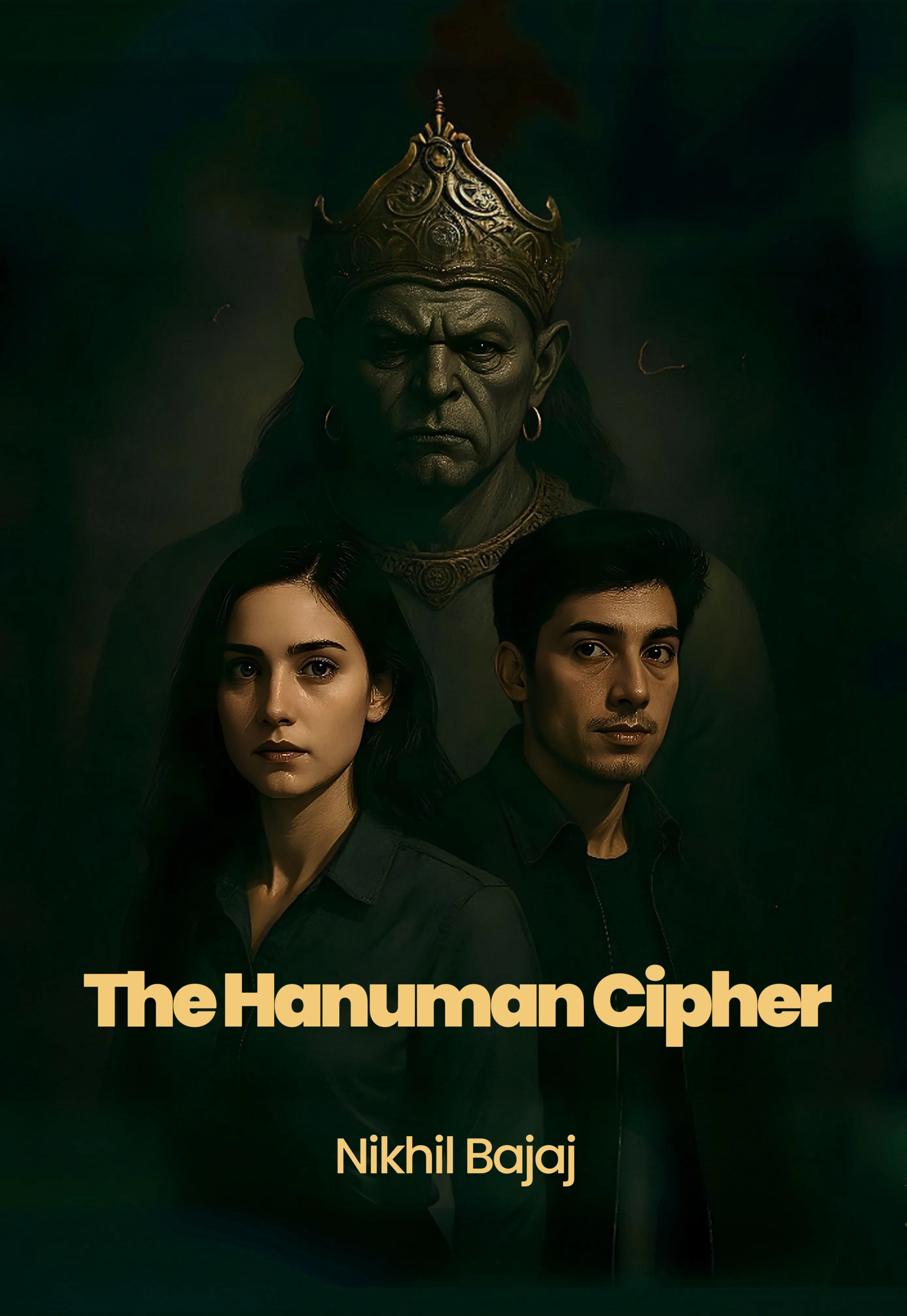
The Hanuman Cipher
A novel by Nikhil Bajaj
What if the gods were the first programmers we ever knew?
At the crossroads of devotion and data. A cryptologist decodes a pattern hidden in hymns and mantras — chants that read less like prayers than algorithms — and awakens something never meant to be found. Myth as memory wrapped in faith.
First pages
Prologue
1: Colaba, Night Shift
Colaba never truly slept. It dozed like a cat with one eye open— rickshaws exhaling, scooters murmuring at idle, the Arabian Sea carrying gossip on its briny breath. Neon bled onto rain-darkened pavement and into the windows of Mumbai Chai & Bytes, a twenty-four-hour café that smelled of cardamom and warm plastic. Rows of rented desktops hummed like a chorus of crickets. Fans ticked. Routers blinked, patient and green.
Samar Nagpal preferred the far table under the flickering tube light, where the wall socket had a loosened faceplate he could nudge with a coin when the UPS forgot itself. He sat with the collapsed posture of a young man who had trained his spine to curve around screens: faded band tee, ripped jeans, a mop of hair that kept falling in his eyes, the distracted genius of someone who held three ideas at once and none of them where he'd put them. He nursed a cutting-sweet chai and watched his terminals fill with numbers.
He had not gone looking for anything heroic. It had started with boredom of a fussy kind—the boredom of a mind underfed by coursework. He pulled recent ISRO datasets for a personal project comparing satellite magnetometer noise against a patchwork of colonial river maps and temple alignments. He liked the awkwardness of it, the way old maps forced modern data to speak sideways. Nights slipped by that way, purposeful and invisible.
Tonight, three scripts chugged along: one cleaning satellite noise, one mapping historical shrines with an algorithm he'd bullied into respecting folklore, the third trying to find rhythms where the world swore there were none. From here he could see the reflection of his graphs in the window—blue ghosts stacked on black—and the owner's son sleeping on a stool beside the counter. A fan blade clicked once per rotation. He matched its click without meaning to, breath settling into four-counts that made the mind less slippery. The café's noise—scooter coughs, a chair scraping, a laugh that didn't land—braided into background while numbers assembled into something that asked to be read.
2: Noise That Wouldn't Behave
On his monitor, a field of faint anomalies rolled by like the static at the edge of a dream. Most were noise—instrument hiccups, cosmic sulks. One set wouldn't sit still. Sub-threshold pulses flickered over a tight cluster of coordinates in the Anjanadri hills of Karnataka, legendary birthplace of Hanuman. They were almost nothing. That was what kept him staring—the way almost-nothing repeated.
The heat in the café was dense, sticky—the kind that made skin itch and thoughts slow. Dust hung in the tube light's glow like suspended questions.
He wrote a filter and then another, the way one checks if the itch is inside the shirt or the skin. The pulses refused to be dismissed. When he laid a transparent layer of ancient pilgrimage paths over the hill contours, a pattern shyly resolved. What if I'm just finding what I want to see? The thought came unbidden, familiar. He swapped the dataset. He re-ran everything with conservative assumptions. It was still there: a lattice that did not yet declare itself, like scaffolding glimpsed through fog. He blinked. His eyes burned. The café owner replaced his empty glass without a word. Samar murmured thanks and tacked a sticky note to the edge of his screen: verify with fresh ISRO pull, different window.
The router hiccuped. A pair of college kids squealed at a video jump scare. Somewhere behind him a chair leg scraped concrete. The night laid out its familiar, unthreatening miscellany. Samar pulled a different period of ISRO data, this one with a slight bias correction he usually distrusted. The lattice sharpened, then softened, like breath fog on glass. Each faint spike coincided with a boundary condition in his temple-alignment model, tiny inflections that tugged at his childhood memory of rummaging through his grandfather's trunk and finding a thin brass idol of Hanuman, arm upraised, as if about to leap.
The chapter continues.
Read all of chapter oneMore in The Echo-Catcher Chronicles