

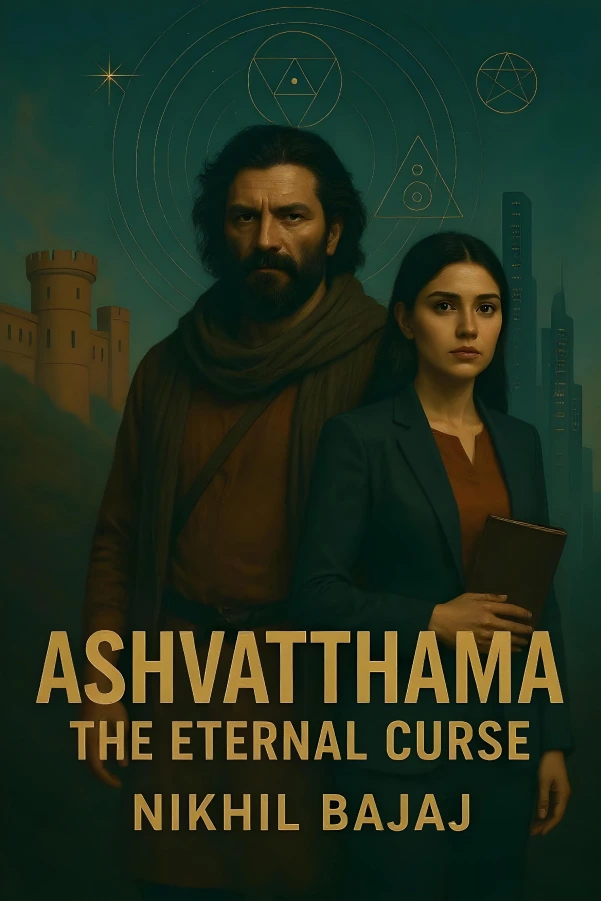
The Echo-Catcher Chronicles
Ashvatthama: The Eternal Curse
A novel by Nikhil Bajaj
What does it mean to endure when endurance itself is the punishment?
A reimagining of one of India's most enigmatic mythological figures — the immortal warrior condemned to walk the earth forever — thrust into a modern world of AI, crime, and destiny. Myth braided with machine logic, curse entangled with code.
First pages
Prologue: The Wound That Walks
I. The Desert of Antiquity
The Rann of Kutch held its breath, a vast, desolate expanse that seemed to absorb all sound, all fleeting human whispers. It wasn't merely the dry, relentless wind that scoured the salt pans, nor the rustle of shifting dunes that permeated the air, but a deeper, ancient thrum. It was a vibration felt more than heard, a profound vibration trapped beneath the earth, a forgotten lament that the very land seemed to have swallowed whole, a secret the world had long since abandoned. The air hung dry and bitter, clinging to the throat, a metallic tang of ancient dust, and the horizon stretched endlessly, pale and stark, like a wound that refused to scab over, bleeding silently into the vast, indifferent emptiness.
He walked across this unforgiving landscape. His bare feet, calloused and hardened by uncounted millennia, moved with a slow, steady rhythm, each step a testament to an unbearable endurance, a silent defiance against the ceaseless march of time. A coarse, undyed shawl, woven from fibres long forgotten by textile looms, draped over shoulders that seemed to bear the cumulative weight of all human sorrows, of forgotten empires and whispered curses. His skin, a tapestry of dry, cracked lines like ancient bark, spoke of an existence far beyond the natural span of human life, an impossible longevity that defied the very laws of decay. His eyes, deep-set and shadowed beneath a perpetually furrowed brow, reflected neither the wide-eyed innocence of youth nor the weary resignation of old age, but rather a tumultuous storm, a tempest of both, held captive within their fathomless depths. And from the very center of his forehead, precisely where the third eye might have opened, a fresh rivulet of blood, thin and dark, a living crimson thread, defied the relentless march of time, sliding perpetually downward, a constant, chilling reminder of his unending torment. He made no move to wipe it away; he never had. He had been bleeding for five thousand years.
His name, once spoken with reverence and awe in the hallowed halls of Hastinapur, was Ashvatthama. He was the son of Drona, the revered guru of princes, the greatest teacher of warfare, and the last valiant commander of the Kaurava army, a loyal and formidable force in a cataclysmic conflict. He was a warrior, forged in the crucible of fire and guided by the unwavering principles of dharma, a man of profound martial prowess. Yet, he was also a man cursed by a god to become something the world no longer recognized, a living paradox. He was not merely a legend whispered around campfires, nor was he a demon summoned from the dark. He was a wound that walked.
II. The Curse
That night, etched into the very fabric of his being, remained as vivid and agonizingly clear as the moment it had unfolded. Kurukshetra. The great war, a cataclysm that had reshaped the very foundations of the world, leaving behind a scarred and grieving land, was finally over. Duryodhana lay broken and defeated on the battlefield, his once-indomitable will shattered. The Pandavas, champions of righteousness, or so the bards sang, had emerged victorious, their triumph echoing across the plains. But for Ashvatthama, there was no echo of triumph, no taste of victory—only the bitter, acidic sting of betrayal, a poison that seeped into his very soul.
His father, Drona, the greatest of teachers, a paragon of wisdom and martial prowess, had not fallen honourably in battle, sword in hand, facing his enemies. He had been slain through a cruel, deceitful trick, a lie, whispered by the righteous Yudhishthira, a man renowned for his unwavering adherence to truth, who had never once uttered a falsehood in his life. Ashvatthama knew, with a certainty that gnawed at his soul like a relentless predator, that this was Krishna’s game, a divine manipulation orchestrated from the shadows, a cosmic chess match with mortal lives as pawns. And so, overwhelmed by a searing storm of sorrow, a grief so profound it twisted into a thirst for his own brutal brand of justice, he sought retribution.
In the pre-dawn darkness, a silence thick with the scent of death and damp earth, he crept into the sleeping Pandava camp, a vindictive phantom. Driven by a vengeful madness that clouded his judgment, he murdered Draupadi’s five sleeping sons, believing them, in his blinding rage, to be seasoned warriors. But they were not warriors. They were children. Innocents. The sun rose, painting the sky with hues of nascent horror, crimson streaks across the dawn, and with it, the screams began, tearing through the quiet camp. And then, Krishna came, his presence radiating an inescapable power, a quiet authority that silenced the very air.
“You have not slain warriors,” Krishna’s voice resonated, calm yet devastating, each word a hammer blow to Ashvatthama’s soul. “You have murdered the future.” Ashvatthama’s sword, heavy with the weight of innocent blood, clattered to the ground, a metallic groan in the sudden quiet. Krishna’s gaze, unyielding and condemnatory, pierced him to the core, stripping away his very essence. “For this, you shall live—but never heal. You shall walk this earth until the end of the Yuga. Alone. Bleeding. Watching. Remembering”.
Then, with a touch that seared through flesh and spirit, a divine fire that left no mark yet burned eternally, Krishna touched him—precisely between the eyes. The pain came instantly, a blinding, all-consuming agony that transcended mere physical torment. And with it, the blood began to flow. It never stopped.
The chapter continues.
Read all of chapter oneMore in The Echo-Catcher Chronicles