

Mythology · 21 May 2026 · writing
The Warrior Who Cannot Lay Down His Arms
Why the same handful of myths keep coming back wearing new centuries.
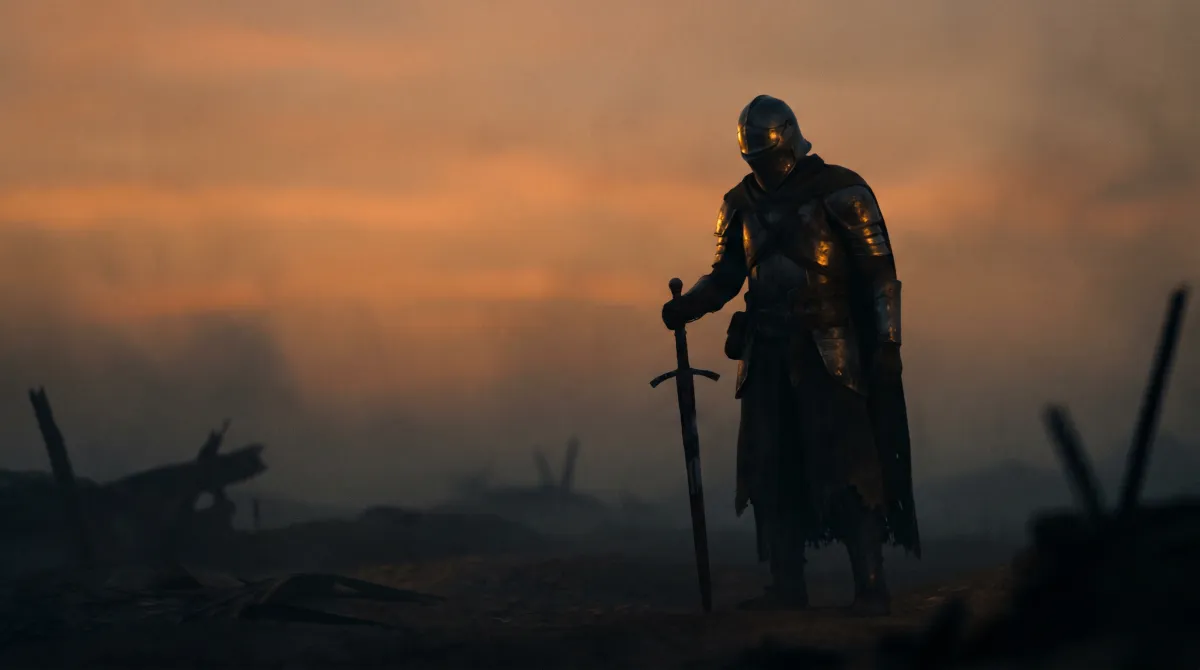
Somewhere around the third novel I stopped being able to ignore it: I keep telling one story. The flood, the fall, the warrior who can’t lay down his arms after the war is over. So does everyone else. We rebuild the same myths because something in us still hasn’t learned the lesson they were built to carry, and a lesson unlearned doesn’t fade — it waits for the next teller.
I don’t think that repetition is a failure of imagination. I think it’s memory doing its job. A myth is compressed experience, wrapped in enough faith to survive the people who lived it. The warrior who outlives the meaning of his own name isn’t a relic; he’s a warning we keep needing to hear because we keep arriving at the same edge with newer tools and the same old hunger to reach past it.
The figure I can’t put down is exactly that one — the soldier who cannot stop fighting once the fighting ends. Peace is the single campaign he was never trained for. The war handed him a self, and when it’s over he keeps the blade raised at a field with no enemy left on it, because lowering it would mean becoming someone he doesn’t know how to be. That’s the immortal in my fiction: not cursed with endless life so much as cursed with a purpose that outlived its reason and never came with a way to set it down.
What unsettles me is how often I meet him off the page. A legacy system is a warrior who cannot lay down his arms — a behavior written for a war that ended years ago, still defending a position nothing is attacking, too load-bearing to retire and too old for anyone to fully remember. We don’t decommission it. We build around it and call the workaround architecture. The myth isn’t a metaphor I reach for; it’s a pattern I keep finding already running in production.
Maybe that’s why the old stories won’t stay buried. A myth is a recovery doc the species refused to delete — the compressed record of a cost we paid once and would rather not relearn from scratch. We keep retelling the warrior because we keep producing him: the person, the institution, the codebase that can’t tell the war is over and keeps fighting it on everyone else’s behalf.
The question I still can’t settle — the one this note is really circling — is whether the myths return because they’re true, or because we keep needing them to be. Every age rewrites them and swears its version is the definitive one. I can’t tell if that’s evidence they encode something real about us, or proof of how little we actually change between the rewrites. I’ve stopped expecting to decide.
So I don’t write him to resolve him. I write him because every few years I meet him again — a new century, a new system, the same raised blade — and I want to understand why none of us, him or his tellers, can quite learn to put the thing down. The day I could answer that cleanly is probably the day I’d stop writing. I don’t expect it to come.