

Systems · 07 May 2026 · engineering
The Cost of a Clean Abstraction
Every model hides the thing it was built to hide — and that’s exactly where the outage lives.
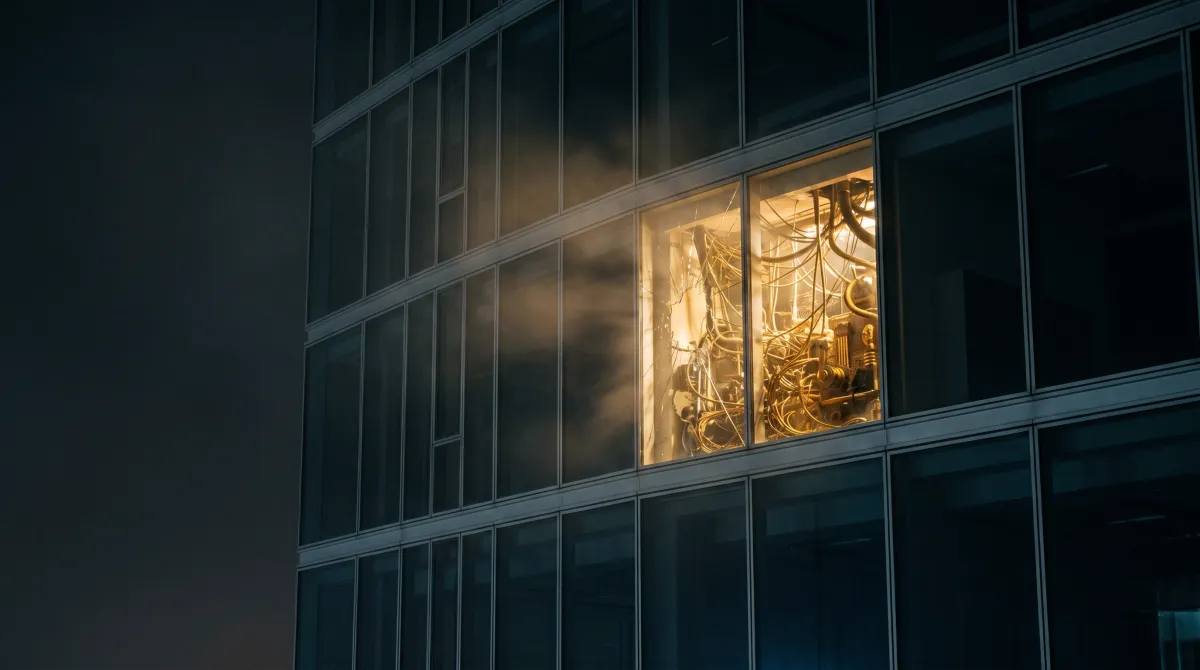
A clean abstraction is a promise: you don’t need to know what’s underneath. Most of the time that promise holds, which is the whole point of building it. The trouble is that the promise is also a hiding place. The detail you abstracted away didn’t leave — it just stopped showing up on the diagram, and a thing that doesn’t show up on the diagram is a thing nobody is watching.
I’ve come to read every tidy interface as useful and suspect in equal measure. The dashboard that says green is a compression of a messier reality, and the gap between the green and the reality is precisely where the slow failure grows. A status that hides a slipping outcome is more dangerous than an honest red one, because it spends your attention before the problem is visible enough to earn it.
The most expensive failure I’ve watched up close didn’t begin with anything breaking. It began with a dashboard that stayed green while the thing it measured quietly came apart underneath it. By the time a number finally moved, the trust was already gone — customers had felt the problem for days our instruments swore were fine. We hadn’t been blind. We’d been reading a clean abstraction that had stopped corresponding to the world and didn’t have the decency to say so.
So I’ve learned to ask a quiet question of every abstraction my teams lean on: what does this make easy, and what does it make invisible? The two are usually the same answer. The migration that “just works” is the one whose rollback nobody has rehearsed. The service everyone trusts is the one whose owner moved on a year ago. The library that hides the hard part is the one nobody left can debug at 3 a.m. when the hard part comes back.
None of this is an argument against abstraction. You can’t run sixty engineers by making everyone hold the whole machine in their head; abstraction is how a system gets large enough to matter at all. The skill was never avoiding them — it’s knowing which ones you’re trusting, and staying honest about what each one keeps out of view. Carrying a quiet map of where the bodies are buried, even in the parts that work.
Which turns into unglamorous habits. We rehearse the rollback for the migration that just works. We put a name on the owner of the service everyone trusts, before that name becomes a question asked in the middle of an incident. We treat a green status as a claim to be audited, not a fact to relax into. It isn’t paranoia — it’s refusing to let a smooth surface sell us a calm we didn’t earn.
Clean is not the same as safe. Clean is sometimes just the silence before you meet the thing the abstraction was keeping out of view. Most weeks the job is to keep visiting the basements of the things that work — on an ordinary Tuesday, by choice — so the abstraction never has to introduce you to its cost on a night of its own choosing.